Credit cards, personal loans, medical bills, store cards…
When you owe money to several lenders, deciding which debt to pay first can feel overwhelming.
Should you start with the smallest balance? Or focus on the debt charging the highest interest?
There are two popular strategies that can help: the Debt Snowball and the Debt Avalanche.
Both involve making regular payments and putting extra money toward one debt at a time. The difference is where you start.
Let’s look at how each works.
First, Build Your Financial Foundation
Before aggressively paying down debt, make sure you have a plan.
At myWealthBeing, we encourage four basic steps toward a strong financial foundation:
- Live below your means. Create a budget that leaves you with money after paying your expenses.
- Build a basic emergency fund. Start with $500–$1,000 to help cover unexpected expenses.
- Pay off unsecured debt. Focus on credit cards, personal loans, and other unsecured balances.
- Build a full emergency fund. Work toward three months of living expenses.
The Snowball and Avalanche methods are tools for that third step.
The key is having positive cash flow—money left over each month that you can use to reduce debt.
The Debt Snowball: Start Small, Build Momentum
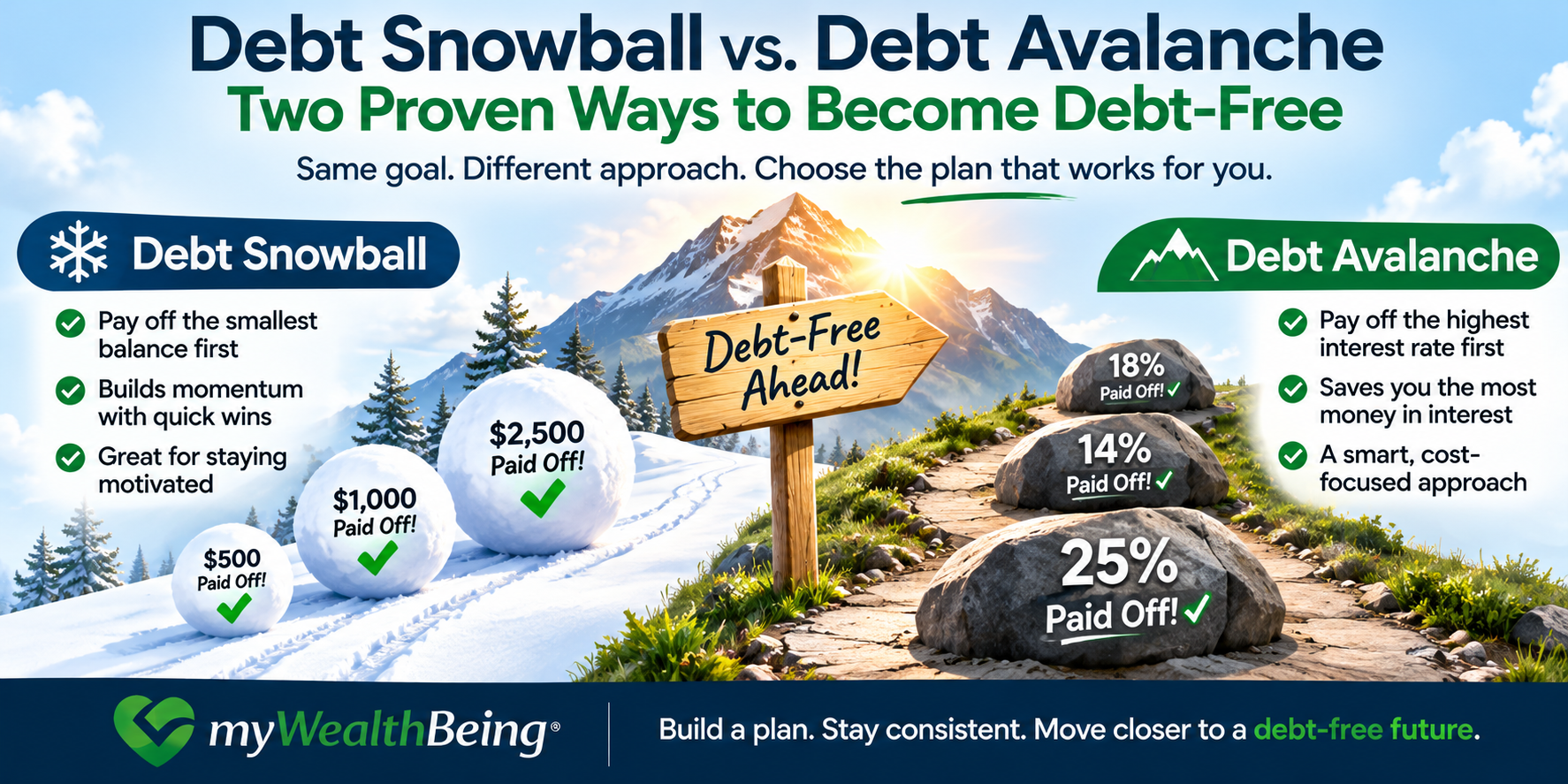
With the Debt Snowball, you pay off your debts from the smallest balance to the largest, regardless of interest rate.
Here’s how:
- List your debts from smallest balance to largest.
- Make the minimum required payment on every debt.
- Put any extra money toward the smallest debt.
- When that debt is paid off, add its payment to the next debt.
- Repeat until all debts are paid.
The idea is simple: each debt you eliminate gives you a small victory and frees up more money to tackle the next one.
Why it works: Paying off smaller debts quickly can help you stay motivated.
The Debt Avalanche: Attack High Interest First
The Debt Avalanche uses a different approach.
Instead of starting with the smallest balance, you focus on the debt with the highest interest rate.
Here’s how:
- List your debts from highest interest rate to lowest.
- Make the minimum required payment on every debt.
- Put extra money toward the debt with the highest interest rate.
- When it’s paid off, move that payment to the debt with the next-highest rate.
- Continue until all debts are paid.
Why it works: Paying down high-interest debt first generally reduces the total interest you pay, assuming the same overall payment amount.
The downside? If your highest-interest debt has a large balance, it may take longer to experience your first payoff victory.
Let’s Compare the Two Methods
Imagine you have these three debts:
| Debt | Balance | Interest rate |
|---|---|---|
| Store credit card | $1,000 | 18% |
| Credit card | $4,000 | 25% |
| Personal loan | $6,000 | 10% |
| Total | $11,000 |
With the Debt Snowball, you would pay them in this order:
Store credit card → Credit card → Personal loan
With the Debt Avalanche, the order changes:
Credit card → Store credit card → Personal loan
Notice something?
You’re paying off the same $11,000 in debt.
You’re simply choosing a different order.
Which Method Is Better?
It depends on what helps you succeed.
| Debt Snowball | Debt Avalanche |
|---|---|
| Smallest balance first | Highest interest rate first |
| Focuses on motivation | Focuses on saving interest |
| Can deliver faster payoff victories | Generally minimizes interest costs |
| Good if you need encouragement | Good if you prefer a mathematical approach |
The best method is the one you’ll actually follow.
Saving money on interest is important. But so is developing the habits and discipline needed to become debt-free.
Coaching Moment: Don’t Lose Sight of the Bigger Goal
Imagine you pay off a $500 credit card.
Congratulations! That’s progress.
But what happens next?
If you start using that card again and carry a new balance, you may find yourself right back where you started.
The Snowball and Avalanche methods aren’t just about making payments.
They’re about changing financial habits.
That means understanding your spending, living below your means, and avoiding new debt while working through your repayment plan.
And remember: you don’t need to find hundreds of extra dollars to begin.
Even an additional $25 or $50 per month can help.
Start with what you can afford, stay consistent, and increase your payments when possible.
One Action Step This Week
Write down all your unsecured debts, including:
- Current balance
- Interest rate
- Minimum monthly payment
Then arrange them two ways: smallest balance first and highest interest rate first.
Look at both lists.
Ask yourself:
Would paying off a small debt motivate me to keep going, or would saving the most interest help me stay focused?
Choose one strategy and make a plan.
Let myWealthBeing Help You Get Started
You don’t have to figure everything out on your own.
At myWealthBeing, we provide free one-on-one financial coaching in English and Spanish.
We can help you review your budget, understand your debts, and develop a repayment strategy that fits your financial situation.
You can also use our free myWealthPortal Debt Snowball tool to organize your debts and explore a repayment plan.
Visit myWealthPortal or schedule a free personalized coaching session through myWealthBeing.
Becoming debt-free doesn’t happen overnight. It happens one payment, one decision, and one good habit at a time.