
Imagine you own a small business.
In December, you complete a project and send your customer a $5,000 invoice. But the customer doesn’t pay you until January.
Here’s the question:
Did your business earn $5,000 in December or January?
The answer depends on how you keep your books.
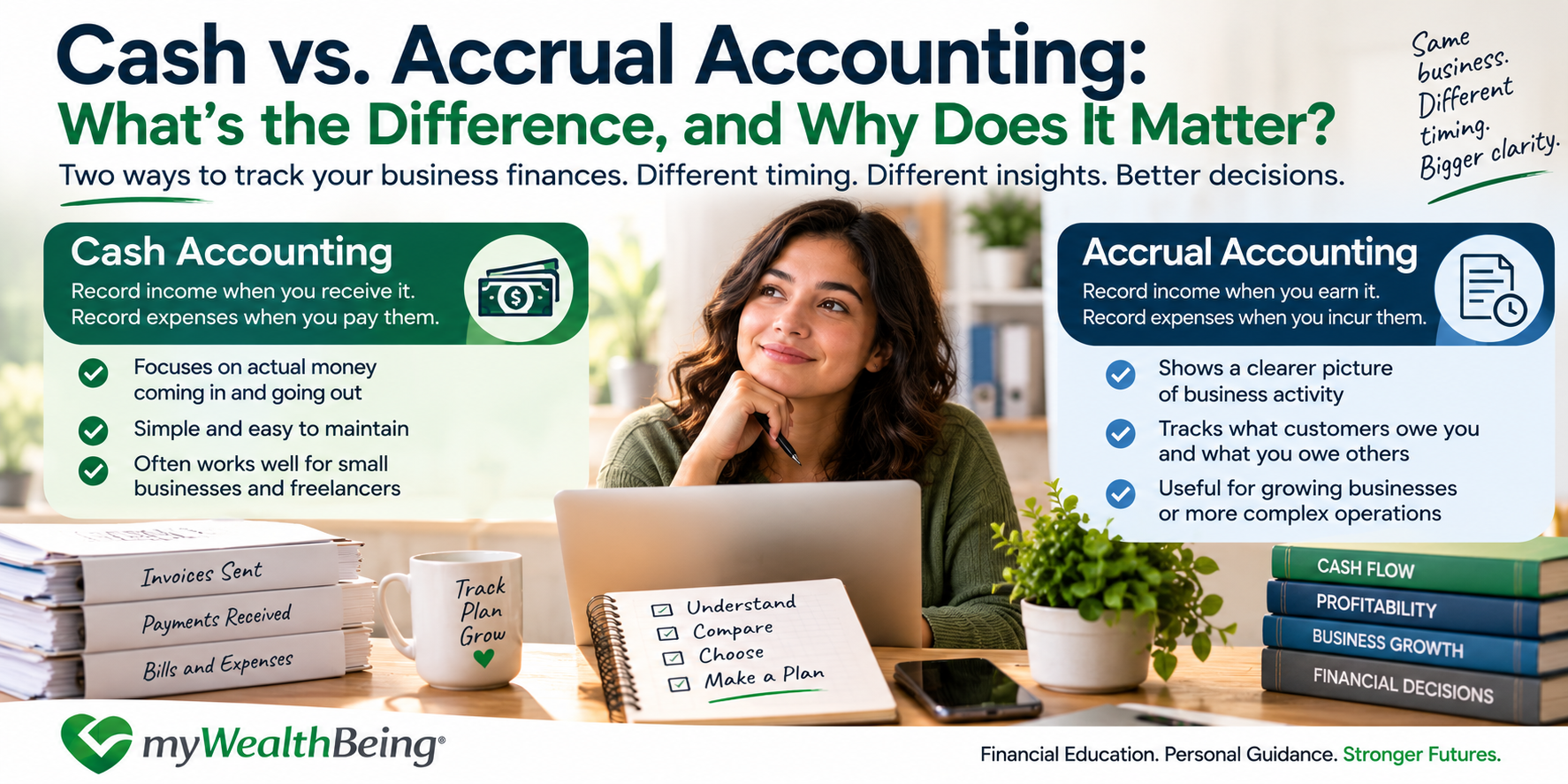
There are two common accounting methods: cash accounting and accrual accounting.
Understanding the difference can help you manage your business, plan for taxes, and make better financial decisions.
1. Cash Accounting: When Money Changes Hands
Cash accounting is straightforward.
You record income when you receive the money and expenses when you pay them.
Let’s go back to our example.
You complete a $5,000 project in December, but your customer pays in January.
Under cash accounting, you generally record the $5,000 as income in January, when you receive the payment.
The same principle applies to expenses.
If you receive a $1,000 bill in December but pay it in January, you generally record the expense in January.
Why small businesses like cash accounting:
- It’s relatively easy to understand and maintain.
- It helps you see money coming in and going out.
- It often works well for freelancers and smaller service businesses.
However, there’s a limitation.
Your business might have completed a lot of work this month, but if customers haven’t paid, your books may show very little income.
2. Accrual Accounting: When Income Is Earned and Expenses Are Incurred
Accrual accounting works differently.
You generally record income when you earn it and expenses when they’re incurred, even if money hasn’t changed hands.
In our example, you complete the $5,000 project in December.
Under accrual accounting, you generally record the revenue in December, even though your customer won’t pay until January.
Likewise, an expense incurred in December may be recorded in December even if you pay it later.
Why businesses use accrual accounting:
- It provides a clearer picture of business activity during a period.
- It helps track money customers owe you.
- It shows expenses the business has incurred but hasn’t paid.
- It can be useful for growing businesses with inventory, invoices, or more complex operations.
The downside?
Accrual accounting can be more complicated, and your business may report a profit even when you haven’t collected the money yet.
3. A Simple Side-by-Side Example
Let’s say your business completes a $5,000 project in December and receives payment in January.
| Cash accounting | Accrual accounting | |
|---|---|---|
| December | No revenue recorded | $5,000 revenue |
| January | $5,000 revenue | No additional revenue |
| When revenue is recognized | When paid | When earned |
Both methods account for the same $5,000.
The difference is timing.
And timing can affect how your business appears to be performing from month to month.
4. Which Method Is Better for Your Business?
Neither method is automatically better.
Cash accounting may be a practical choice if you operate a small service business, have relatively simple finances, and want an easy way to track money received and paid.
Accrual accounting may be more useful if you invoice customers, carry inventory, have significant unpaid bills, or want to understand profitability more precisely.
Some businesses are required to use accrual accounting for certain purposes, while others can choose. Tax rules, inventory, business structure, and revenue levels can affect eligibility.
Before selecting or changing your accounting method for tax purposes, check with a qualified tax professional.
5. Profit Isn’t the Same as Cash Flow
This is perhaps the most important lesson.
Imagine your business reports $10,000 in profit this month.
Sounds great!
But what if your customers haven’t paid you yet?
You might have a profitable business on paper and still struggle to pay your rent, employees, or suppliers.
That’s why every business needs to pay attention to cash flow, regardless of its accounting method.
Cash flow tells you whether you have enough money available to meet your obligations.
Profit tells you whether your business is earning more than it spends under the accounting rules you’re using.
You need to understand both.
Coaching Moment: Don’t Confuse Sales With Money in the Bank
One of the most common mistakes new business owners make is assuming that a successful month of sales means they have money available to spend.
But a sale isn’t always a payment.
And money in your bank account isn’t necessarily all yours to spend.
Some of it may be needed for upcoming bills, taxes, payroll, or other business obligations.
Here’s a useful habit:
Review three numbers regularly:
- How much money is in your business bank account?
- How much money do customers still owe you?
- How much money do you owe others?
Those three numbers can help you avoid financial surprises.
One Action Step This Week
Take a look at how you’re currently tracking your business income and expenses.
Ask yourself:
Am I recording transactions when money changes hands, or when the work is done and the expenses are incurred?
Then review your outstanding customer invoices and unpaid bills.
Even if you use cash accounting, keeping track of these amounts will help you manage your business more effectively.
Need Help Understanding Your Business Finances?
At myWealthBeing, we offer free, personalized one-on-one financial coaching.
We can help you understand your business cash flow, organize your income and expenses, build a budget, and prepare for conversations with your accountant or tax professional.
Our role is to educate, coach, and mentor—not to replace your accountant.
Schedule a free one-on-one meeting with myWealthBeing.
Remember, running a successful business isn’t just about making sales.
It’s about understanding your numbers and using them to make better decisions.