
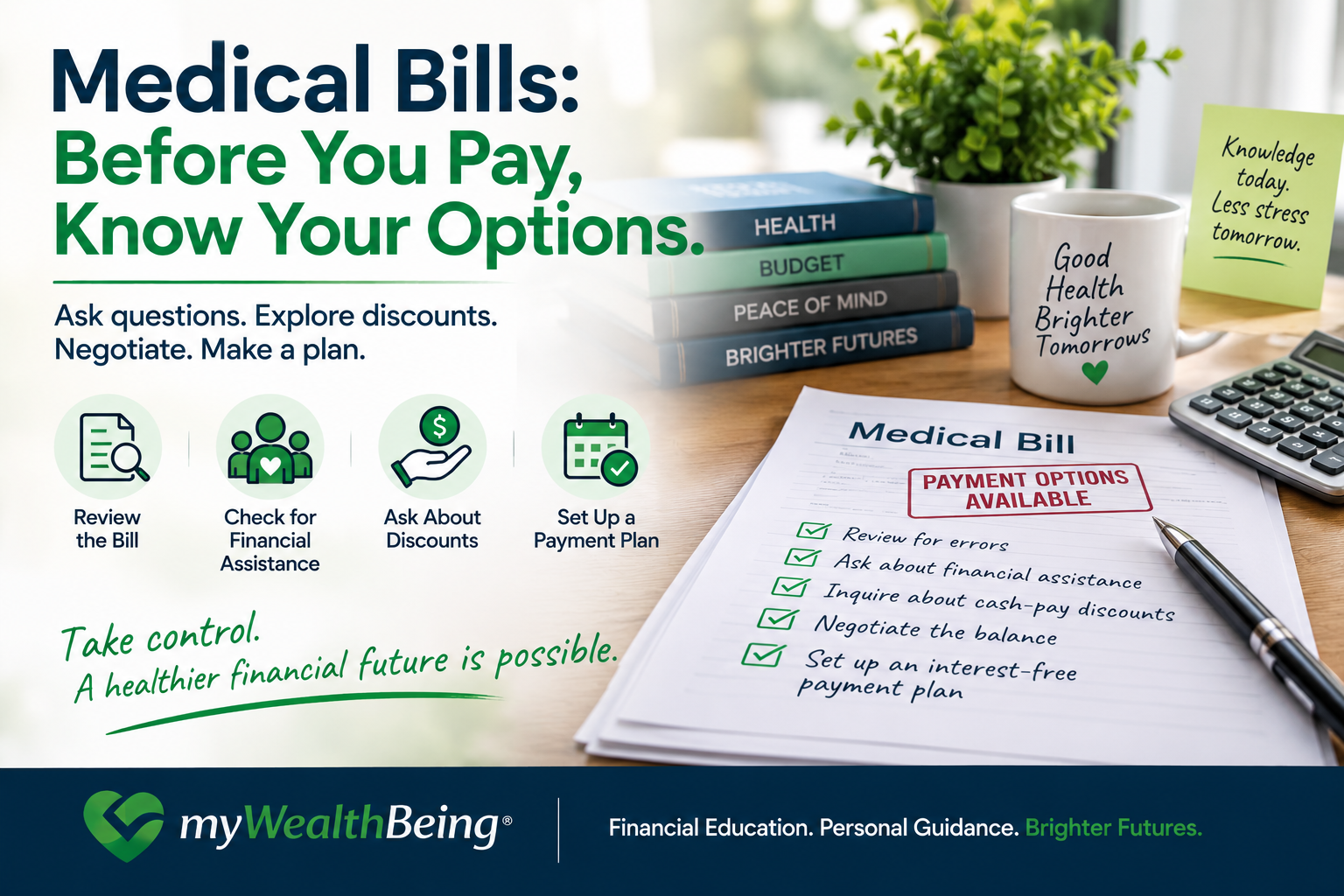
A medical emergency can create two problems at once.
First, you’re dealing with your health. Then the bills start arriving.
Maybe you owe $500. Maybe it’s $5,000. Maybe it’s much more.
Before putting that bill on a credit card, taking out a personal loan, or simply accepting the amount you’re being asked to pay, remember:
Medical bills can sometimes be negotiated.
The key is to explore your options while the debt is still with the hospital or medical provider.
Help Yourself First
One of the biggest mistakes you can make is immediately paying a large medical bill with a credit card.
Why?
Because while the bill remains with the medical provider, you may have several options:
- Correct billing or insurance errors
- Apply for financial assistance or charity care
- Ask for a self-pay or cash-pay discount
- Request a prompt-pay discount
- Negotiate the balance
- Arrange a 0% payment plan
Once you use a credit card or another loan to pay the provider, the hospital bill is paid.
Now you owe the credit-card company or lender instead—and you’ve generally lost your ability to negotiate that medical bill with the provider.
Explore your medical-bill options first. Borrow money to pay it only after you’ve determined those options don’t work for you.
1. Make Sure You Owe the Right Amount
Before negotiating, ask for an itemized bill.
Compare it with your insurance Explanation of Benefits (EOB), if applicable.
Look for duplicate charges, services you don’t recognize, insurance payments that aren’t reflected, or charges that should have been covered.
You can also use FAIR Health Consumer to research typical costs for medical services in your area.
FAIR Health provides free healthcare cost information that consumers can use when discussing and negotiating charges with healthcare providers.
Knowledge gives you negotiating power.
2. Ask About Financial Assistance or Charity Care
Before discussing a payment plan, ask:
“Does your hospital have a Financial Assistance Policy or charity care program, and can I apply?”
This can be one of your best options.
Under IRS Section 501(r), nonprofit hospitals must maintain a written Financial Assistance Policy explaining eligibility for free or discounted medically necessary care and how patients can apply.
Eligibility varies by hospital, so don’t assume you make too much money to qualify. Ask.
If you qualify, your $5,000 bill might be reduced substantially before you ever begin negotiating repayment.
Also ask whether the financial assistance policy covers all the providers involved in your care. A hospital’s policy may not necessarily cover every independent physician or provider who treated you at the hospital.
3. Ask About Self-Pay, Cash-Pay or Prompt-Pay Discounts
Even if you don’t qualify for financial assistance, there may be other discounts.
Ask:
“Do you offer a self-pay or cash-pay discount?”
Or, if you have enough savings to make a lump-sum payment:
“If I pay this balance in full today, what prompt-pay discount can you offer me?”
These discounts are different from formal charity care. In fact, IRS guidance specifically distinguishes self-pay and prompt-pay discounts from a hospital’s Financial Assistance Policy.
Don’t be afraid to ask.
The worst answer is simply no.
4. Negotiate
Why would a hospital negotiate a bill that you legitimately owe?
Think of the old saying:
“A bird in the hand is worth two in the bush.”
A provider may prefer a reliable payment today—or a dependable payment arrangement—over uncertainty about whether the full balance will eventually be collected.
So ask.
For example:
“My balance is $3,000. If I can pay $2,000 today, can you accept that as payment in full?”
They don’t have to accept your offer. FAIR Health notes that providers aren’t required to reduce their fees, but some may negotiate or offer payment arrangements when asked.
If they agree to reduce the balance, get the agreement in writing before paying.
5. Negotiate the Payment, Not Just the Balance
Sometimes the provider won’t reduce what you owe.
That’s okay.
Your next negotiation can be about time.
Suppose you owe $3,000 and the hospital offers an interest-free payment plan.
Instead of putting $3,000 on a high-interest credit card, you might say:
“I can afford $50 per month. That would allow me to pay this balance over five years. Can you create a 0% payment plan at that amount?”
They may counter with another amount.
Now you’re having a negotiation.
And here’s where your budget matters.
Don’t agree to $200 per month because someone on the phone tells you that’s the minimum if you know your budget only has room for $75.
You can respond:
“I’ve reviewed my budget. I can’t reliably pay $200, but I can commit to $75 every month. What options do you have that would make that work?”
A good payment plan isn’t the one that pays the hospital fastest.
It’s one you can actually maintain without creating another financial problem.
What’s the Best Outcome?
Think about medical debt in this order:
Correct the bill → Apply for financial assistance → Ask for discounts → Negotiate the balance → Negotiate a 0% payment plan → Consider borrowing only as a last resort.
You don’t necessarily need every strategy.
You simply want to find the best available option before turning medical debt into another type of debt.
Know Your Rights
There are also some important protections to understand.
Nonprofit hospitals subject to IRS Section 501(r) must make reasonable efforts to determine whether a patient qualifies for financial assistance before taking certain extraordinary collection actions. Their financial assistance policies must also explain eligibility and how to apply.
That doesn’t mean you should ignore your bills.
Quite the opposite.
Open the bill. Ask questions. Apply for assistance. Negotiate early. Keep records of your conversations. And get agreements in writing.
Coaching Moment: Don’t Be Embarrassed to Ask
Many people feel uncomfortable negotiating medical bills.
But you’re not asking someone to pretend the bill doesn’t exist.
You’re saying:
“I want to resolve this. Help me find a way that works.”
That’s responsible financial behavior.
Medical debt is different from buying something you couldn’t afford. Often it comes from an illness, accident, surgery, or other situation you didn’t choose.
Give yourself permission to ask questions and advocate for yourself.
Your Four Questions
If you’re dealing with a medical bill, call the billing department and ask:
1. Do I qualify for financial assistance or charity care?
2. Do you offer a self-pay, cash-pay, or prompt-pay discount?
3. If I can make a lump-sum payment, what discount can you offer me?
4. If I can’t pay in full, can you offer me a 0% payment plan based on what I can realistically afford?
Write down the name of the person you spoke with, the date, what was discussed, and any offer that was made.
And don’t move the balance to a credit card until you’ve explored these options.
Need Help Preparing for the Conversation?
Sometimes knowing what to ask is easier than knowing what you can afford.
myWealthBeing offers free one-on-one financial coaching. We can help you review your budget, understand your cash flow, organize your medical and other debts, and prepare for your conversation with the provider.
We don’t negotiate the bill for you.
We help you understand your numbers and prepare to negotiate for yourself.
Schedule a personalized meeting with myWealthBeing, and let’s build a plan together. 💚